


Clinical Precision in Practice: A Style Italiano Perspective on Pulp Vitality Testing

When Style Italiano Honorary Member Dr. Giuseppe Chiodera documented his clinical workflow with the Digitest 3 pulp vitality tester in June 2021, he focused on the practical details that often separate successful technique from theoretical knowledge.
Dr. Chiodera, who graduated from the University of Studies Brescia in 2004 and specializes in aesthetic and conservative dentistry, approaches diagnosis with meticulous attention to detail. His practice in Brescia, located between the mountains and lakes of northern Italy, handles complex cases requiring precise pulp vitality assessment—from monitoring deep restorations over time to diagnosing teeth with full-coverage restorations.
The Details That Matter
In his clinical report, Dr. Chiodera documented specific techniques he developed through practical use:
The eyebrow test: “It’s important to notice, in addition to the patient’s conscious response, also and above all the unconscious response given by the eyebrows,” he wrote. “When the patient starts frowning, it means that he is starting to feel pain. This is the first signal.”
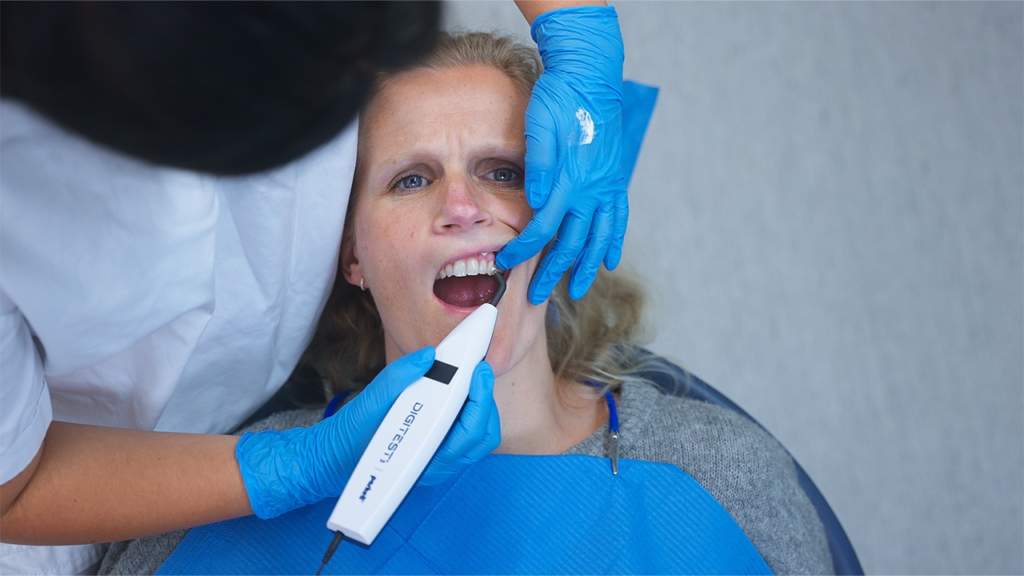
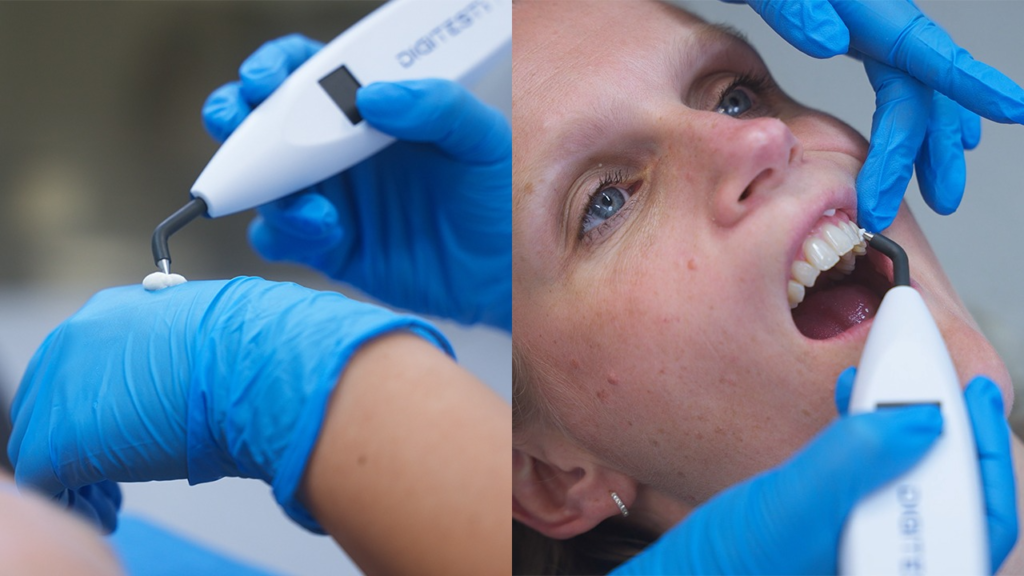
The colored gel technique: To prevent electrical conduction to adjacent teeth, he recommends colored toothpaste gel. “If you want to check that the gel does not touch other teeth, I suggest you to use a colored gel, to work as a stain with teeth and gum.”
Baseline testing: Before testing a questionable tooth, he always tests a healthy reference tooth—both to verify instrument function and to help the patient understand what sensation to expect.
These details reflect the type of clinical refinement that comes from repeated use in a high-volume aesthetic practice where patient comfort and diagnostic accuracy both matter.
Two Distinct Clinical Applications
Dr. Chiodera identifies two primary uses in his practice:
1. Initial diagnosis: Determining if a tooth remains vital, particularly in cases where thermal testing is unreliable (crowned teeth, extensive restorations)
2. Longitudinal monitoring: “If we made a deep restoration or a pulp hooding we need to check over time if this restored tooth is still alive or is most probably no longer viable,” he explained in his report.
This monitoring application—tracking pulp vitality over months following conservative treatment—represents a shift from one-time diagnostic testing to serial assessment.
The Patient Experience
“Compared to other tests such as the traditional cold cotton one, Digitest 3 is less annoying for the patient, as we can modulate the discharge intensity,” Dr. Chiodera noted. “Immediate understanding by both the clinician and the patient.”
The device’s 0-64 scale provides quantifiable data that can be communicated clearly to patients and tracked over time—important in aesthetic practices where patients expect transparency in treatment planning.
Technical Design for Clinical Reality
The Digitest 3’s four autoclavable probe tips address the access challenges Dr. Chiodera documented: the thin curved tips is ideal for palatal access to abutments and distal access to crowns while the straight thin tips is essential to test exposed collars. His clinical photographs demonstrate testing through crowns, onlays, and other restorations—scenarios where traditional thermal testing often fails.
The device is CE certified under EU medical device regulations and manufactured by Parkell, whose European headquarters is located in Upplands Väsby, Sweden.
A Teaching Resource
Dr. Chiodera’s clinical report, published through Style Italiano, serves as a teaching resource for practitioners implementing electric pulp testing. His step-by-step photographic documentation covers the practical challenges—gel placement, probe positioning, patient communication—that aren’t typically covered in manufacturer instructions. As someone who lectures at university masters courses and shares clinical techniques internationally, Dr. Chiodera’s contribution reflects the value of practitioner-generated protocols in advancing clinical practice.