

Predictable Management of Deep Carious Lesions: A Clinical Perspective on Bioactive Restorative Materials
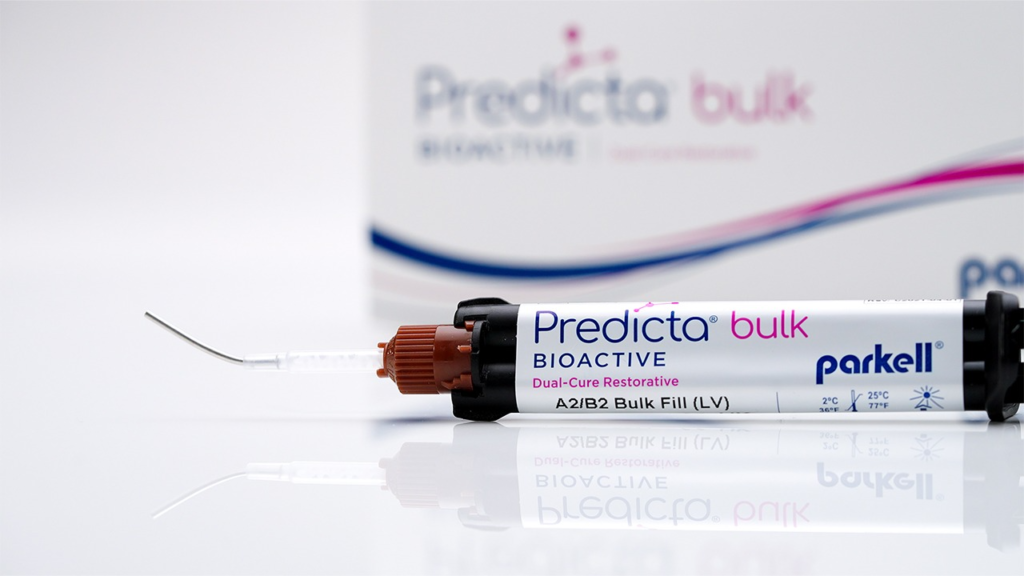
When Dr. Deepak Mehta encounters a patient with a deep carious lesion and a high caries index, his priority is not simply restoring what has been lost, but it is rather reducing the risk of recurrence. He documented a detailed case study using Parkell’s Predicta Bioactive Bulk, published in a clinical report that walks step-by-step through his decision-making and technique.
Dr. Mehta brings considerable academic depth. Holding a BDS degree, a Master’s Certificate in Conservative Dentistry and Endodontics, a Post Graduate Certificate in Aesthetic Dentistry and a PhD in Dental Materials, he served as Professor in the Department of Conservative Dentistry and Endodontics at V.S. Dental College and Hospital in Bangalore, adjunct professor of dental materials at Yenepoya Dental College in Mangalore, and visiting professor at the University of Sharjah, UAE. He is a founding member of the International Association of General Dentistry and a member of the American Society for Dental Aesthetics. His practice in Bangalore focuses on esthetic dentistry with an emphasis on minimally invasive and adhesive approaches.
The Problem with Passive Restoratives
Dr. Mehta opens his clinical report by addressing a fundamental limitation of conventional composite resins. “The weakest link in a composite restoration is the interface between tooth structure and restorative material,” he writes, “where micro gaps trap biofilms, leading to secondary caries and post-operative sensitivity.”
This is not a minor concern. As Dr. Mehta states plainly: “Secondary caries is the primary cause of composite resin restoration failure.” Despite decades of advances in bond strength and polymerization shrinkage, conventional composites remain passive once placed, as they do not interact with the surrounding tooth structure to resist the very process that causes most restorations to ultimately fail.
The development of bioactive composite resins represents a response to that limitation. Unlike conventional materials, bioactive composites release calcium, phosphate and fluoride, creating a precipitate of hydroxyapatite at the material-tooth interface.
The Case: High Caries Risk, Deep Lesion
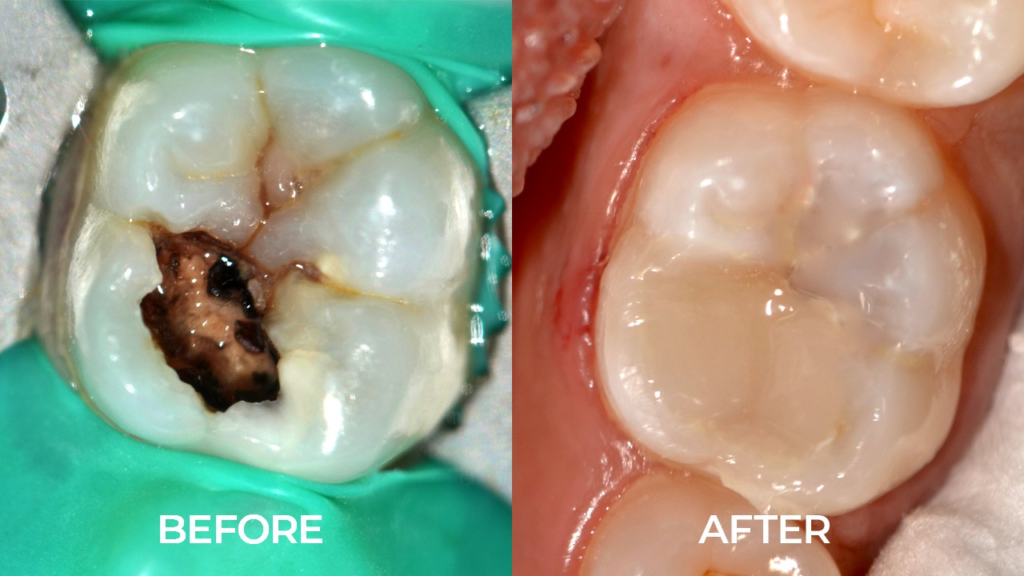
Dr. Mehta’s clinical report centers on a female patient presenting with sensitivity and occasional pain on stimulus in her lower left first molar. Clinical examination revealed a deep carious lesion. The tooth was not tender to percussion. Radiographic examination confirmed a deep lesion near the pulp, with no significant periapical changes.
Critically, the patient had a high caries index. This detail influenced the choice of restorative material. “The patient had a high caries index and therefore a bioactive restoration with Predicta Bulk was considered,” Dr. Mehta explains. For a patient already demonstrating elevated susceptibility to caries, placing a passive restorative material would not provide the same bioactive mechanism intended to counteract recurrent caries at the same margin.
The Technique: Preserving What Remains
Following rubber dam isolation, Dr. Mehta performed deep caries excavation using a stainless-steel spoon excavator and a polymer bur. The polymer bur technique is significant: it selectively removes infected dentin while leaving affected dentin intact, preserving as much viable tooth structure as possible.
Selective etching with phosphoric acid followed, applied for 20 seconds. After rinsing and gentle air-drying, Parkell’s Universal Adhesive was applied using a rubbing motion for 20 seconds, followed by a second coat for an additional 20 seconds. The surface was air-thinned for 10-15 seconds to evaporate the solvent before light-curing for 20 seconds.
For the restorative placement itself, Dr. Mehta used the bendable metal-tipped mixing tip provided by the manufacturer — a design detail he notes as particularly useful for directing the material into the deepest portion of the cavity preparation. Starting from one junction of the cavity box, Predicta Bulk was injected to fill the entire preparation. Because the material is dual-cure, Dr. Mehta followed the manufacturer’s recommendation to wait at least one minute before light-curing.
Two Consistencies, One Clinical Goal
Predicta Bulk is available in two consistencies, high viscosity and low viscosity, giving clinicians flexibility in placement depending on cavity geometry and depth. The post-operative radiograph demonstrated the material’s clinical reach, with excellent radiopacity clearly revealing the depth and extent of the restoration.
Four Months Later
At the four-month follow-up, the restoration remained intact with no marginal failure. No signs of gingival inflammation or increased plaque accumulation were observed. Given the patient’s established high caries index, Dr. Mehta describes the outcome as a “satisfactory clinical performance.”