


Interview with Dr. Simona Giani on Digitest 3 Pulp Vitality Tester

Accurate pulp vitality testing is critical for making the right treatment decisions in dentistry. Conventional methods such as cold tests, hot gutta-percha, or cryotests often come with limitations. To understand how electronic dental devices like Digitest 3 are changing diagnostics, we spoke with Dr. Simona Giani, an experienced dentist from Varese, Italy.
She has been practicing for over 20 years and teaching at renowned universities across the country. Below is a detailed Q&A where she talks about her perspective on the role of Digitest 3 in dental diagnostics.
Question: Dr. Simona Giani, could you please introduce yourself to our readers?
Answer: Good morning! My name is Simona Giani, and I’ve been running my dental practice in Varese, Italy, for over 20 years. I am an active member of the Italian Academy of Conservative and Restorative Dentistry. With that, I am also a founding member of the Italian Society of Dental Prosthetics. I also maintain a strong interest in professional development, regularly attending events organized by the Italian Society of Periodontology.
Moreover, teaching has always been one of my passions. I’ve taught at several universities including the School of Specialisation in Paediatric Dentistry at the University of Trieste. Also, the School of Specialisation in Orthodontics and in the course of Dental Hygiene in Varese. Including in the Master of Endodontics at the University of Bologna and I also lecture at national and international congresses.
Question: You’ve worked with both conventional and modern diagnostic methods. What makes pulp vitality testing so important?
Answer: Pulp vitality testing is essential for distinguishing between vital, necrotic, or compromised teeth. Conventional methods — like cold tests, hot gutta-percha, or cryotests — can be inaccurate and can only detect whether a tooth reacts to a stimuli or not. An electronic pulp vitality tester, such as Digitest 3, is also dependent on patient response. But it provides reliable, repeatable, and precise results that give clinicians greater confidence in treatment decisions.
Question: How did you first come across Digitest 3?
Answer: I first discovered Digitest 3 soon after my graduation, while working in the clinic of my mentor, Dr. Franco Brenna, in Como. I immediately loved the tool for its ease of use and its ability to support accurate diagnosis. When I opened my own clinic, I searched for it. But unfortunately, it wasn’t available in Italy for a while. Thankfully, the new Digitest 3 is now available through main Italian distributors, and I quickly added it to my practice.
Question: What makes Digitest 3 such a valuable tool in diagnosis?
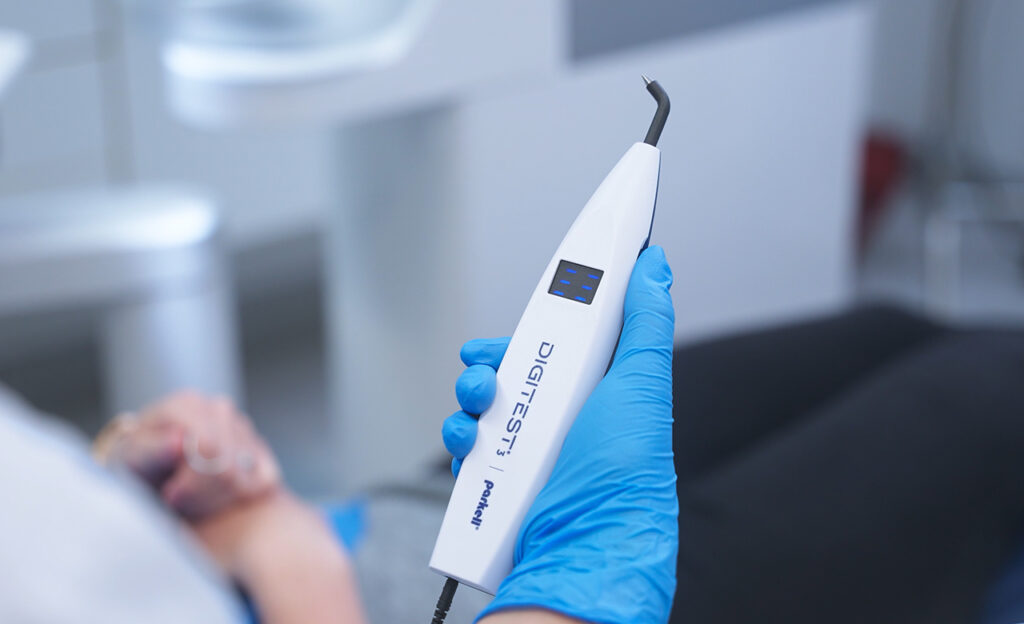
Answer: Digitest 3 is a rapid, accurate, and non-invasive electrical pulp vitality tester. It helps distinguish between vital, necrotic, or gradually deteriorating teeth. The ability to measure, compare, and monitor tooth vitality over time is incredibly important. This precision has raised the level of diagnosis in my clinic.
Question: How do you usually perform the Digitest 3 procedure?
Answer: I typically use the intermediate speed on a dry tooth, with cheek retractors and cotton rolls. I apply a small portion of toothpaste on the enamel — making sure it doesn’t touch the gingiva — and place the probe in it. It is very important that the toothpaste does not come in contact with the gingiva. Because if crevicular fluid comes in contact with the toothpaste it risks invalidating the test. The patient signals when they feel the impulse, while my assistant reads the number immediately for accuracy. What matters is not the absolute number, but the variation over time and comparison with the contralateral or antagonist tooth.
Question: In which cases do you rely on Digitest 3 the most?
Answer: I use it every time a patient reports diffuse pain, not clearly identifiable to a single tooth, before restorations in very deep carious lesions, for direct or indirect pulp capping, and after restorations. Recording and comparing results over time helps me decide whether a tooth can be preserved or if endodontic treatment is needed.

Question: Has Digitest 3 replaced traditional vitality testing methods in your practice?
Answer: Yes, absolutely. Since I’ve had Digitest 3, I no longer use other methods like hot gutta-percha, ice, or cryotest. I still complement the diagnosis with percussion tests and mobility assessments. But when it comes to vitality testing, I rely solely on Digitest 3.
Question: for a general dentist with a strong focus on restorative dentistry like yourself, what are the assets of equipping your clinic with a Digitest 3?
Answer: Being basically a conservative dentist – of teeth and of their vitality – even in case of very deep carious lesions. I try to keep a vital tooth, taking some risks. Digitest 3 allows me to monitor over time whether my choice was correct. For example, in a tooth with a very deep carious lesion I perform the test before the restoration to assess whether the tooth is vital. And something you can only do with an electric tester to determine the number it reacts to.
And a few days after the restoration I expect a lower number because the tooth may be hyper-reactive and inflamed. After a few months I will repeat the test to verify if the results are getting close to the contralateral or the antagonist tooth. Comparing the same numerical values at every check up allows me to understand whether that tooth is gradually losing vitality and requires endodontic treatment
Question: Beyond clinical benefits, does Digitest 3 offer advantages for patients?
Answer: Definitely, apart from improving diagnostic accuracy, it also has a valuable psychological impact on patients. Seeing their results translated into numbers helps them better understand the condition of their teeth and the reasoning behind treatment decisions. Even in cases of vitality loss that require endodontic treatment.
Question: To conclude, what is the greatest advantage of using Digitest 3 in your daily practice?
Answer: The greatest benefit lies in its precision and ability to measure and monitor tooth vitality over time. It allows me to conserve teeth whenever possible and make more informed decisions ultimately providing patients with higher-quality, confidence-driven care.
Undoubtedly, Dr. Simona Giani’s insights highlight just how valuable Digitest 3 can be in dental diagnostics. If you’re ready to bring the same precision, now is the perfect time to explore Digitest 3. Don’t let uncertainty compromise your diagnosis .Upgrade to Digitest 3 today and bring precision to every treatment decision.You can now order your Digitest 3 here or visit our website for more information.
“It gives me countless advantages. It takes diagnosis to a higher and more precise level. Being a conservative dentist, when faced with very deep carious lesions, I try to keep the tooth vital, taking some risks. The Digitest 3 allows me to verify and monitor over time whether my choice was correct.”
-Dr Simona Giani, Dentist